
Scholarship Program Management System: How to Run One
Key takeaways
- Complete, eligible, scored and decided are four separate states; an incomplete application is not an ineligible one, and a high score is not an award.
- Write the rubric and its level descriptors before applications open, review without names, and record a consensus score with its reason and the authority behind it rather than quietly averaging a disagreement.
- Approved, scheduled and cleared are three different payment states, and an award with conditions outstanding should block payment rather than appear as money already given.
In this guide 9 sections
- Four states that should never share a column
- Write the rubric before applications open
- Review without names, and handle disagreement openly
- Payment is the fifth state, and the one that drifts
- Tie the fund back to the ledger
- Decide whether a spreadsheet is the right place at all
- Keep the cycle documented while it runs
- Tools that help
- Where to start
An award programme is judged on fairness, and fairness turns out to be mostly a record-keeping problem. The test comes when an unsuccessful applicant writes to ask why. If the answer exists only in a reviewer’s memory, the programme has a problem that no amount of good intention fixes, and the pressure to reopen a decision that was probably correct becomes hard to resist.
The second test is money. Scholarships pay out over months or years, often in instalments, often with conditions attached, and the gap between what was approved and what has actually reached a student is where most programmes lose track. This guide covers the states a scholarship system has to keep apart, how to review without names, what a payment gate is for, and the point where a spreadsheet stops being an appropriate place for records about named young people.
Four states that should never share a column
Collapsing these into one status field is the single most common cause of a decision nobody can explain later.
| State | The question it answers | Who decides |
|---|---|---|
| Complete | Are all required documents present and accepted | Administrator |
| Eligible | Does the applicant meet every mandatory rule | Administrator, against written rules |
| Scored | What did reviewers assess against the rubric | Reviewers |
| Decided | What did the committee officially award | Committee, minuted |
An incomplete application is not an ineligible one: a missing transcript is a chasing task, while a failed residency rule is a decision. A high score is not an award: the committee can decline a strong application because the fund is exhausted or because a condition cannot be met, and that is a legitimate outcome as long as it is recorded as one.
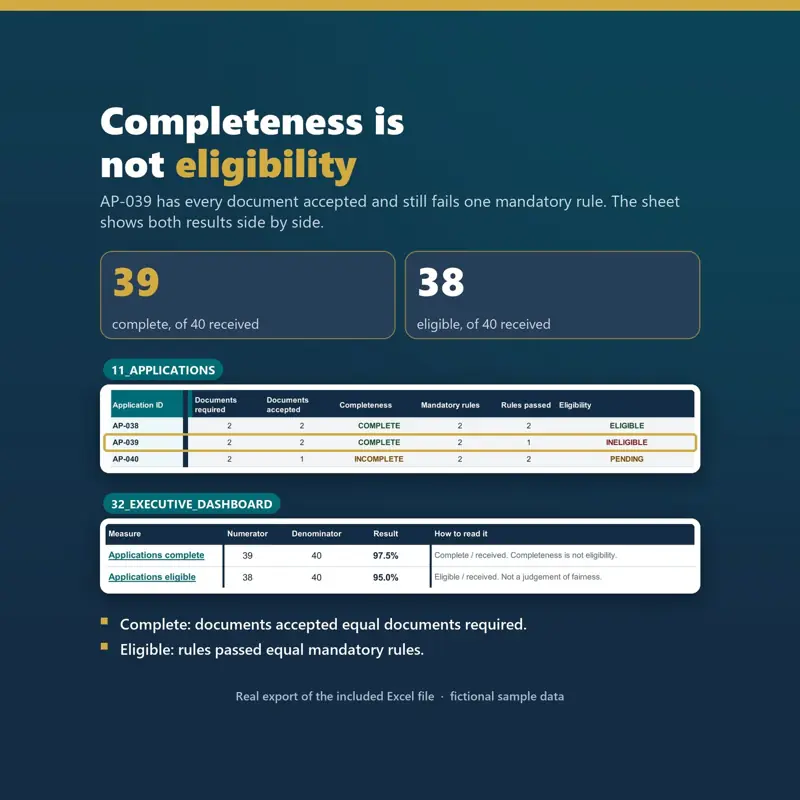
The demo cycle of the Scholarship & Grant Award Program System shows the distinction working. Application AP-039 has all of its documents accepted, so it counts as complete, and still returns INELIGIBLE because only one of two mandatory rules passed. On the dashboard that reads as 39 complete and 38 eligible out of 40, which is exactly the kind of one-row discrepancy that a single status column would hide.
Write the rubric before applications open
A rubric written after the applications arrive is a rubric written around the applicants, and reviewers can feel it even when nobody intends it. Set the criteria, the weights and the level descriptors first, publish what you can, and leave them alone for the cycle.
Level descriptors are the part most programmes skip. A criterion scored 0 to 5 with no description of what a 3 looks like produces scores that vary more between reviewers than between applicants. One sentence per level is enough, and it does more for consistency than any amount of reviewer briefing.
Weights should be few and round. In the demo rubric of the award system, two criteria carry weights of 60 and 40 against a score range of 0 to 5, so a raw score of 5 on the first criterion contributes 60.00 weighted points. Anyone can check that arithmetic in their head, which is the property you want when a decision is questioned.
One borrowed rule is worth applying from proposal review: mandatory items are checked before anything is scored, and a criterion nobody has scored yet stays blank rather than counting as zero. The Grant Proposal Scoring Matrix is built around that order, sorting rules into mandatory, scored and informational and returning DO NOT SUBMIT on a confirmed mandatory failure whatever the average says. A scholarship panel that averages in the unscored criteria will hand a weak application a respectable number and never see why.
Review without names, and handle disagreement openly
Reviewers who can see names, schools and addresses are being asked to ignore information they cannot unsee. Give them an identity-free pack instead: the application reference, the answers, and nothing that identifies the person. The award system ships a Reviewer Pack in blank and demo editions for exactly this, so reviewers score without names while the administrator keeps the link between reference and applicant.
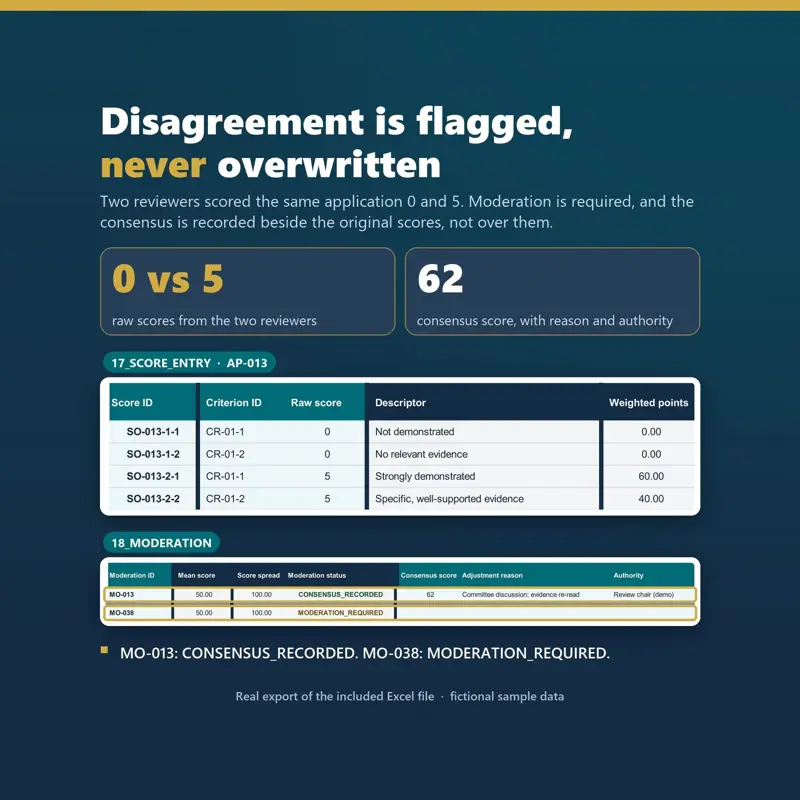
Disagreement is not a failure of the panel, and averaging it away is the wrong instinct. When two reviewers score the same application 0 and 5, the mean of 50.00 describes neither of them. What belongs on the record is that the disagreement was flagged, that a consensus score was set — 62 in the demo file — and the reason for it, together with who had the authority to set it. Six months later, that row answers the question an applicant asks. The mean alone does not.
Payment is the fifth state, and the one that drifts
Once the committee decides, most programmes relax, and the award register starts to be read as if the money has gone out. It has not. Approved means a decision exists. Scheduled means an instalment has a date. Processed means someone sent it. Cleared means it arrived.
The difference is not pedantry. In the demo disbursements of the award system, instalment PA-003-1 reads CLEARED with 1,750.00 against it, while PA-004-1 has a processed date and 0.00 valid cleared, so its award AW-004 shows 3,500.00 committed and 0.00 cleared. A programme reporting on committed money would describe that student as funded. The student would disagree.
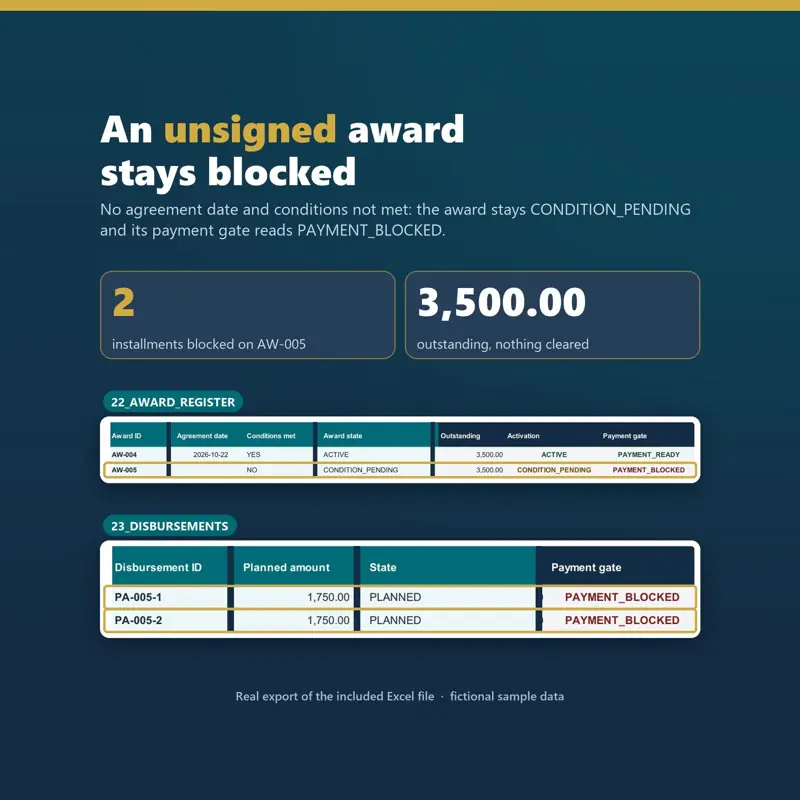
Conditions deserve a gate of their own. Award AW-005 in the same file has no agreement date and conditions marked NO, so its state reads CONDITION_PENDING and both instalments read PAYMENT_BLOCKED with 3,500.00 outstanding. Building the block into the sheet rather than into someone’s diligence is what stops a payment going out against an agreement nobody signed.
Tie the fund back to the ledger
A scholarship fund is restricted money, and it behaves like any other restricted grant: the amount committed to students is not the amount that has left the bank, and neither figure is the balance available for next year’s cycle. Keep the award register and the ledger joined by tagging every transaction with the fund it belongs to.
The fictional pantry in the Nonprofit Treasurer Spreadsheet example demonstrates the arithmetic on a grant rather than a scholarship, but the shape is identical: against a book balance of 20,232, one grant has received 6,000 of a 12,000 award and spent 3,200, leaving 2,800 restricted, and the funds total back to the book balance. Run the same check on a scholarship fund each month and an over-committed cycle shows up while there is still time to stagger the intake.
Decide whether a spreadsheet is the right place at all
A scholarship file is a file about named young people. It usually holds dates of birth, household income, school records and sometimes disability or immigration status, and it is often shared with volunteer reviewers over email. That combination deserves a deliberate decision rather than a default.
Three questions settle it. Do you need to know who changed a figure and when. Does each reviewer need to see only their own assignments. Would a leaked copy cause material harm to an applicant. A yes to any of them points away from a shared workbook and towards software with audit logs and row-level permissions. The Client Case Management System is one of the few template systems that ships a suitability check saying when a spreadsheet is the wrong tool for a record, along with a migration workbook for planning the move, and its reasoning transfers directly to award programmes.
Where a spreadsheet is reasonable — a modest programme, a small panel, a controlled file — the mitigations are ordinary: one copy with one owner, the identity-free pack for reviewers, personal data kept out of file names and email subject lines, and a retention date on the cycle so unsuccessful applications are deleted rather than archived indefinitely.
Keep the cycle documented while it runs
The last piece is the one that makes next year cheaper: writing down what happened while it is still happening. Which rules caused the most ineligibility, where applicants dropped out, which criteria produced the widest reviewer spread, how long each phase actually took.
The award system covers that ground across a workbook set shipped as a DEMO with fictional data, a BLANK workbook, a BLANK Simple view of 18 tabs and a BLANK Standard view of 26 tabs, with the lifecycle laid out as 22 numbered phases that each name who acts, which tab, and the exit condition. Alongside it come 7 Canva designs covering 22 communication templates across 47 pages, and 30 Word templates in A4 and US Letter as guided and clean versions. It is explicitly not an applicant portal, a payment processor or an automatic winner selector: people make every decision, which is the right division of labour for a programme that has to be explained.
Tools that help
- Scholarship & Grant Award Program System: runs a scholarship, fellowship, bursary or microgrant programme from application to closeout, with an identity-free Reviewer Pack and payment states that block on outstanding conditions.
- Grant Proposal Scoring Matrix: checks mandatory items before scoring, supports up to 8 reviewers with variance flags, and leaves an unscored criterion blank instead of counting it as zero.
- Nonprofit Treasurer Spreadsheet: tags every transaction with a fund so a restricted scholarship balance stays visible against the reconciled book balance.
- Client Case Management System: includes a suitability check that says when a spreadsheet is the wrong place for records about named individuals, and a migration workbook for the move.
Where to start
Before the next cycle opens, do two things. Write the eligibility rules as a numbered list where each rule is pass or fail, and write one sentence describing each level of each rubric criterion. Those two documents take an afternoon and remove most of the arguments a panel can have. Everything after them — the reviewer pack, the moderation record, the payment gate — is the same discipline applied to the next stage, and each of them exists so that the answer to why still exists when somebody asks for it.
Keep reading
All guidesBest Nonprofit Grant Management Spreadsheet: How to Choose
GrantsThe six jobs that get called grant management, four tests to run on any spreadsheet template before you commit to it, and when a spreadsheet is the wrong tool.
Grant Management for Small Nonprofits: A Practical Guide
GrantsHow small nonprofit teams screen funders, forecast a grant pipeline honestly, build and review proposals, check budgets, and track restricted awards.