
Nonprofit Sponsorship Tracker Template: What to Track
Key takeaways
- Secured, paid and delivered are three separate states; a single status column cannot answer the one question a renewal meeting opens with.
- Every promised benefit needs an owner, a due date and a piece of evidence recorded at signing, not reconstructed eleven months later.
- Cash and in-kind belong in separate columns with the valuation method written down, and a waived benefit comes out of the denominator rather than counting as a failure.
In this guide 9 sections
- Secured, paid and delivered are three different things
- What a benefit row needs
- Cash and in-kind are two budgets
- Fulfilment is a ratio with a denominator worth arguing about
- Renewal readiness, scored before the meeting
- Event sponsorship needs its own file
- The proposal and the tracker should share a spine
- Tools that help
- Where to start
A partnership manager walking into a renewal meeting gets one question before any others: which of the things we promised did the sponsor actually receive. It sounds like a reporting question. It is really a record-keeping question, and it is decided eleven months earlier, at signing, by whether anyone wrote the promises down in a form that can be checked.
Most sponsorship trackers are built as a pipeline, because sponsorship feels like sales. The pipeline half is the easy half. The half that decides whether there is a second year is the fulfilment ledger, and it is the part that usually does not exist. This guide covers what belongs in a sponsorship tracker, the states teams keep collapsing into one column, and how to arrive at a renewal meeting with evidence rather than recollection.
Secured, paid and delivered are three different things
One hopeful status column is the most common fault in a sponsorship sheet. A partner marked confirmed might have signed and not paid, paid and received nothing, or received everything and still be unlikely to renew. Those are four different conversations, and the column flattens them into one.
Keep three states apart, each with its own date:
- Secured. An agreement exists in writing. A verbal yes from a marketing manager is a prospect, not a sponsor.
- Paid. Money has cleared. Committed and received are separate figures, and the gap between them is a finance problem long before it is a relationship problem.
- Delivered. Each promised benefit has been provided and evidenced. This is the only one that can be partially true, which is why it needs its own ledger rather than a tick.
The Sponsorship Proposal Bundle organises a whole cycle around that separation, running inventory, packages, the prospect pipeline and benefit fulfilment with proof attached to each benefit from one Excel workbook of 20 sheets, shipped as a filled-in DEMO edition and a BLANK edition. Eighteen Canva designs carry the proposals and decks, which matters less than the fact that the proof sits beside the promise in the same file.
What a benefit row needs
Write the benefit rows at signing, from the agreement, while the detail is still in front of you. Each row carries five things.
| Field | Why it is there |
|---|---|
| Benefit | The specific promise, in the sponsor’s words |
| Owner | One named person inside your organisation |
| Due date | When it has to happen, not the quarter |
| Evidence | The link, photo or screenshot that proves it |
| State | On Track, Watch, At Risk or Critical, with a reason |
Evidence is the field that gets skipped and the field that does the work. A logo on the website is evidenced by a dated screenshot of the page, not by a memory of having uploaded it. A mention at the event is evidenced by the run sheet and a photo. Collect it when it happens: reconstructing twelve months of proof in the week before a renewal meeting is how teams end up quietly dropping the claim.
Owner has to be a person. A row that reads “comms team” produces no action in any meeting, and benefits fail far more often from nobody owning them than from anyone refusing.
Cash and in-kind are two budgets
A sponsor who gives 20,000 in cash and a sponsor who gives 20,000 of donated printing have not given the same thing, and adding them produces a sponsorship total that overstates what the organisation can spend. Keep in-kind in its own column with the valuation method written beside it, and keep the method consistent between sponsors.
The same discipline applies to the value you put on your own benefits. A fit score and a working value for a sponsorship package are assumptions, not facts, and writing them down as assumptions is what lets you revise them next year without an argument. Resist putting a market price on benefits you have never sold; if a sponsor asks, say what the benefit costs you to deliver and what comparable organisations charge, and label both.
Fulfilment is a ratio with a denominator worth arguing about
Fulfilment is benefits delivered divided by benefits promised. The complication is the benefits the sponsor waived: a company that declined its table at the gala has not been failed, and leaving those in the denominator makes the number read worse than reality while hiding the benefits you genuinely missed.
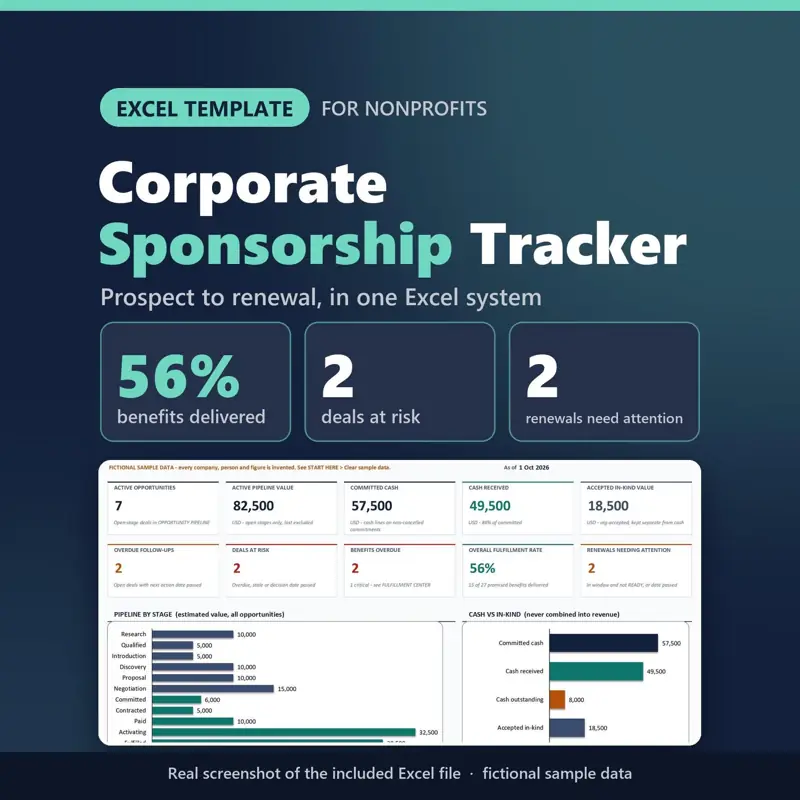
Take waived benefits out, record who waived them and when, and the ratio becomes something you can show a sponsor. The Corporate Sponsorship Tracker works this way across the whole partner list: every promised benefit is flagged Critical, At Risk, Watch or On Track with a plain-English reason, money received is tracked separately from money committed, and the Next Action Center gives one action per partner. In its fictional sample, 15 of 27 promised benefits are delivered, 49,500 of 57,500 committed cash has arrived, and the top action is a website logo benefit now 37 days late.
That last detail is the point of the ledger. A logo that is 37 days late is a ten-minute fix while it is visible and an awkward silence in a renewal meeting once it is not.
Renewal readiness, scored before the meeting
Renewal is usually treated as a date. Treating it as a score, calculated from what the tracker already holds, changes what happens in the three months before that date.
A readiness score has four honest components: fulfilment rate, payment status, relationship activity since signing, and whether the sponsor has had any result reported back to them. A score that names its weakest component is more useful than a number alone, because the weakest component is the thing to fix. The Corporate Sponsorship Tracker scores Renewal Readiness from 0 to 100 and names that component, and the scores are rule-based and editable, so you can argue with the weights rather than with the output.
What a readiness score deliberately does not do is predict renewal. There is no probability in it, because the variable that decides most renewals is a budget decision inside the sponsor’s organisation that nobody at your end can see.
Event sponsorship needs its own file
Sponsorship around a single gala or conference behaves differently enough that it rarely belongs in the year-round partner tracker. Tickets sold, guests registered and guests attended are three different numbers. Cash and in-kind are two different budgets. And the closeout, which is where most of the value leaks, has to happen while the obligations are still open.
The Fundraising Gala & Sponsorship System runs one event from a 31-sheet connected workbook, shipped as a working copy, a BLANK master for the next event and a DEMO edition filled with a fictional gala. It opens with a go/no-go score across 15 viability factors, plans 49 starter tasks on a 30-week timeline, budgets across 13 income and 22 cost categories, and ends with a 14-gate closeout that refuses to show complete while money or obligations are still open. Save a fresh copy per event rather than stretching one file across years.
The proposal and the tracker should share a spine
Trackers go stale when the promises inside them were invented by the deck rather than drawn from an inventory. If the proposal offers a benefit nobody owns, the fulfilment ledger inherits a row that was never going to be delivered.
The cure is to build packages out of an inventory of things you can actually provide, and to write the case once rather than per sponsor. The Donor Pitch System applies that to the case for support: an evidence library of 150 rows where every statistic carries a source, a period and a review date, and a story bank of 60 rows that records consent before a story can be used. Its readiness score cannot pass while an unsourced statistic or a story without consent is open, which is a reasonable rule to apply to a sponsorship deck as well.
Tools that help
- Corporate Sponsorship Tracker: follows each partner from prospect to renewal, flags every promised benefit with a reason, and scores Renewal Readiness 0 to 100 naming its weakest component.
- Sponsorship Proposal Bundle: an Excel workbook of 20 sheets covering inventory, packages, pipeline and benefit fulfilment with proof, plus 18 Canva designs for the proposals.
- Fundraising Gala & Sponsorship System: a 31-sheet workbook for one event, with a 15-factor go/no-go score and a 14-gate closeout that stays open while obligations are.
- Donor Pitch System: a 25-sheet workbook that holds an evidence library of 150 rows and a story bank of 60 rows, with consent recorded before use.
Where to start
Take your three largest current sponsors and write out every benefit each one was promised, from the agreement rather than from memory. Put an owner, a due date and a link to evidence against each row. The gaps that appear in that first hour are the renewal risk you already have, and most of them are still fixable. Everything else in a sponsorship tracker can wait until that ledger exists.
Keep reading
All guidesGivingTuesday and Christmas Fundraising Plan for Small Nonprofits
FundraisingA backwards-planned GivingTuesday and Christmas appeal for small teams: timelines, one season map, proof checks for content, matching gifts and thank-yous.
Nonprofit Fundraising and Donor Retention: A Working Guide
FundraisingPractical methods for small nonprofit fundraisers: LYBUNT and SYBUNT lists, contact cadence, thank-you standards, year-end projections and season planning.