Cargo Dashboard: Shipment, Container & Freight Cost Tracker
Rp178.592 on Etsy, prices shown in your currency at checkout
US$14.99 on Gumroad, priced separately from the Etsy sale
Cargo Dashboard is an instant download. Sample data in the demo file is fictional and clearly marked.
A small freight forwarder usually knows which shipments are late. The trouble is that it is normally the customer who asks first.
Shipment data goes stale in the gaps between tools: an ETA in an email, a status in a chat, a cost in an invoice folder. One row per shipment, with a controlled status list and a single date convention for ETD, ETA, ATD, ATA and delivery, is enough to make lateness visible without anyone chasing it. The same discipline applies to money: record expected and actual lines per shipment and let margin stay blank when there is no revenue yet, rather than printing a misleading 0%.
What changes is the order of the conversation. Delays, missing documents and thin-margin lanes surface on a Monday morning queue instead of in a complaint.
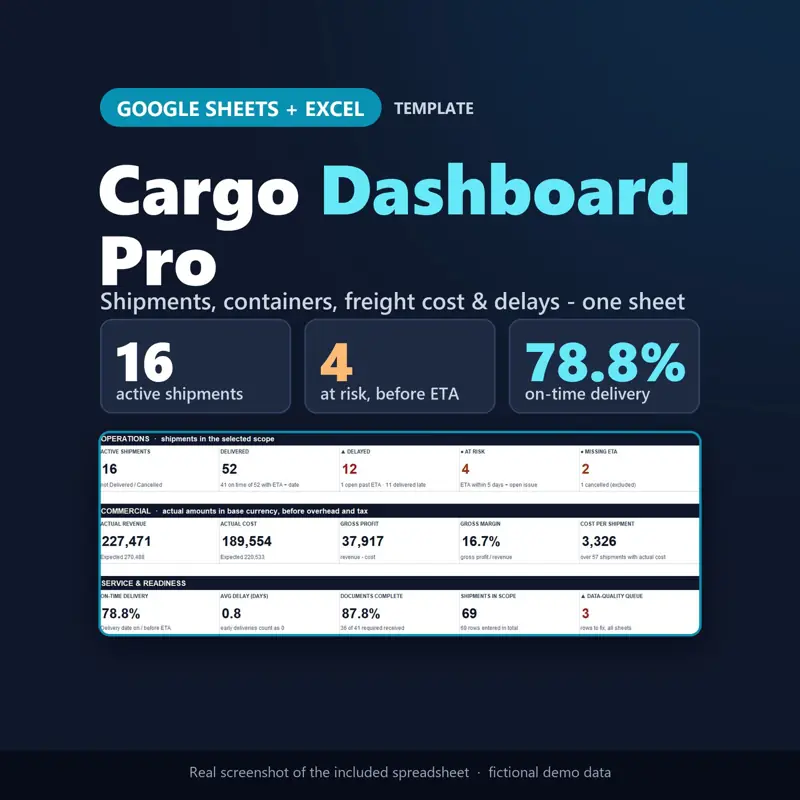
The Cargo Dashboard is a 13-tab Google Sheets and Excel system. SHIPMENTS holds one row per shipment with 13 controlled statuses, customer, carrier, route, Incoterm, owner and next action, and calculates schedule health as LATE, AT RISK, MISSING ETA or ON TRACK. The dashboard reports active, delivered, delayed and at-risk shipments, revenue, cost, gross profit and margin, on-time delivery percentage, average delay days and document completion, with a top-12 exception queue and filters by period, direction, mode and customer. Containers carry a last-free-day countdown, costs are multi-currency with an FX rate you type, and the KPI guide states every numerator, denominator and blank rule. The DEMO workbook holds a fictional freight company with 69 sample shipments; every one of the 240,653 formulas was calculated in Microsoft Excel with 0 errors and opened in Google Sheets with identical results.
It is not live tracking: there is no GPS, vessel AIS, carrier or customs API, so you enter statuses and dates yourself. It is not customs, legal or accounting advice, Incoterms are recorded rather than interpreted, and there is no automatic currency conversion or demurrage and detention calculation.